Friday, June 7, 2024

Simple history of Korea & a visit to the DMZ

In 1392, King Taejo founded the Joseon dynasty that ruled Korea for more than 500 years. During most of this time, the country remained isolated. King Taejo also invented the Korean alphabet. Before the Korean alphabet, Chinese was used. Interestingly, North Korea was using it since the 1950s while South Korea only adopted it in the 1990s.


Portrait of King Taejo in the Shrine of Felicitous Foundation in Jeonju


In the second half of the 19th centuries, Korea opened up to the outside world and particularly to the west. In 1910, the Japanese empire invaded Korea, demolished lots of old structures (buildings, palaces, etc). As Japan lost in World War II, Korea was divided in 1945 between US/ UN in the South and China and Russia in the North as the agricultural population was not seen as mature enough to rule themselves. 


By 1950, north and south had established own governments and the leader of North Korea decided to invade the south. A three year war period followed that led to an armistice. Both countries remained close in their development for several years, the North showing even better growth for some time. From the 19x0s, they went on a different trajectory.


Fence at the DMZ


Checkpoint to enter the DMZ 


In South Korea, several tour operators offer visits to the DMZ (Demilitarised Zone) which is two kilometres north and south of the boarder. At the time of my travel, visits to the Joint Security Area (JSA)at Panmunjom were suspended as in July 2023 an American soldier had crossed into North Korea during a tour. My tour started very early in Seoul (I was picked up at 6:30 in Itaewon). 

By 7:30, we had reached Imjingak Park where a visitor centre informs about the Korean war times. Our guide took our passports and application list to get tickets from the government office - there was a run on the tickets as there seemed to be more demand than tickets. At 9, he got the tickets and the assigned time for the government bus. 

I had booked a small tor with a visit to a suspension bridge as I thought it belonged to the DMZ. Instead the suspension bridge was only a tribute to South Koreans’ favourite pastime of hiking and has no historic connection. So feel free to skip it.


Suspension bridge


Tour highlights:


Imjingak Park

The visitor centre features several memorials to the Korean war, to reuniting families, to the girls that were enslaved by the Japanese as sex workers for the army. There is showcased a locomotive that has many bullet holes tand which was derailed in the Korean war, the freedom bridge over which prisoners of war were exchanged after the armistice. The park was built for South Koreans to commemorate their North Korean family members before the DMZ was opened.


More and more buses arrive


1950 locomtive with bullet holes


Freedom bridge


 Peace Momunment for "Comfort Women"


3rd infiltration tunnel

So far, South Korea has discovered four tunnels that the North has built to infiltrate the South - they were discovered between 1975 and 1990. More are expected to have been drilled. Some of the four tunnels are open to the public on a DMZ Tour. I visited the third tunnel. Before you go down, you watch a video with a strong American voice talking about the history of the DMZ, the tunnels and the wildlife - it feels strongly like propaganda.


To go down, you have to store your bags and phone in a locker, walk through a security check and take a helmet. Then you walk down a steep ramp for 375 m (down the interception tunnel). At the bottom I saw a wall that was prepped for the dynamite to clear the next couple of meters. I then walked 265 m in direction to North Korea, where the third concrete blockade with a window to see the second blockade marks the closest point you can get to North Korea (170 m). For this tunnel, it’s really good to be small as the tall ones dinged quite a lot to the ceiling of the tunnel.


Ready to enter the tunnel


Dora Observatory 

On the Dora mountain, is the observatory with binoculars directed at North Korea - I could see Chaeson Industrial Complex, Chaeson (city), propaganda village, fields, North Korean military post and radio towers from both side that should block signals from the opposing side. While I looked through the magnifying glass, I did not see any North Korean.


We are watching you!


View of North Korea


Unification Village

The bus stopped there for a 15 min shopping break at a DMZ grocery store that offered products from the zone: rice, alcohol, other food items. That felt a bit like a Kaffeefahrt (cheap coach trip with a sales show).


Unification Village


DMZ Supermarket


Thursday, June 6, 2024

Gyeongju & Andong: Pagodas, Pavilions, and the Shape of History

Gyeongju and Andong came next, and together they formed one of the most culturally dense stretches of the trip. Gyeongju, often called the museum without walls, was once the capital of the Silla Kingdom (57 BCE–935 CE), which ruled much of the Korean Peninsula for nearly a thousand years. That weight of history is felt everywhere.


Combining new and old designs

From the train station, it took about 90 minutes, involving two buses and a short taxi ride, to reach my hotel. By the time I walked in, slightly travel-worn, it became clear just how few foreigners pass through this particular setup. I must have been the only one that day. The receptionist greeted me by name, handed me the key without further ceremony, and pointed out the breakfast time. No small talk, no explanations—just quiet efficiency.

The room was spacious, the breakfast very basic, but the location was excellent, which mattered far more. Everything I wanted to see the next day was close, and in Gyeongju, proximity to history is everything.


Overview Bulguk-sa

Former entry to Bulguk-sa

The following day, I visited Bulguk-sa, one of Korea’s most important Buddhist temples and a UNESCO World Heritage Site. Originally constructed in the 8th century during the height of Silla power, it represents the kingdom’s spiritual and artistic peak. Within the temple complex stand Dabotap and Seokgatap, two stone pagodas that perfectly illustrate the balance and restraint of Silla craftsmanship—one ornate, the other austere, both intentional.


Dabotap                          Seokgatap


From there I continued to Seokguram Grotto, completed in the mid-8th century and now also a UNESCO site. The stone Buddha, seated calmly inside the granite grotto and facing the East Sea, is considered a masterpiece of Buddhist sculpture in East Asia. Even with modern visitor management, the space retains a quiet intensity. It feels less like a monument and more like a presence.


Bus to Seokguram

Little fresh snack from the bus stop


Seokguram


In the afternoon, I returned to the hotel, picked up my luggage, and made my way to the intercity bus terminal, heading north to Andong.


Checking the app again and again until the local bus finally shows up


By late afternoon, I arrived in Andong, where EJ and Miyoung were waiting for me—an immediate shift from solo travel to shared experience. After Korean BBQ dinner, we went to Wolyeonggyo Bridge, beautifully lit at night. We took a moon boat ride, drifting slowly beneath the illuminated structure, the reflections moving quietly across the water. 


Wolyeonggyo Bridge


That night we stayed in a more luxurious hanok, a clear contrast to my functional hotel in Gyeongju. The craftsmanship, space, and silence made the stay feel intentional rather than merely practical.


Our luxurious hanok by night and day


The next morning we visited Manhyujeong Pavilion, a site with real historical weight beyond its more recent fame as a K-drama filming location. Built during the Joseon Dynasty (1392–1897), the pavilion is associated with Confucian scholars and literati, serving as a place for study, reflection, and poetry. Pavilions like this were central to Joseon intellectual life, designed to frame nature rather than dominate it. Standing there, it was easy to see why the location still resonates on screen centuries later.


Manhyujeong Pavilion

the modern scholar looking for wifi or the best photo

We then headed into Andong city for lunch. The pedestrian zone offered a brief tonal shift: alongside traditional references were comic-style figures, playful and slightly unexpected, adding a light, almost whimsical layer to a city otherwise known for seriousness and tradition. After lunch, we stopped for pastries at Mammoth, a welcome modern pause.


Andong mascots


In the afternoon, we visited Hahoe Folk Village, another UNESCO World Heritage Site and one of the best-preserved examples of a Joseon-era clan village. Dating back to the Joseon period, the village still reflects Confucian social order in its layout and architecture. Unlike open-air museums, Hahoe is still inhabited, which gives it a quiet continuity rather than a staged feel. But you also have to pay attention not to end up in someone's backyard.


Hahoe Folk Village


From Andong, we drove back to Seoul by car, the scenery slowly flattening and modernising as we returned to the capital.


Tuesday, June 4, 2024

How to travel in South Korea - your options

T-Card & public transport

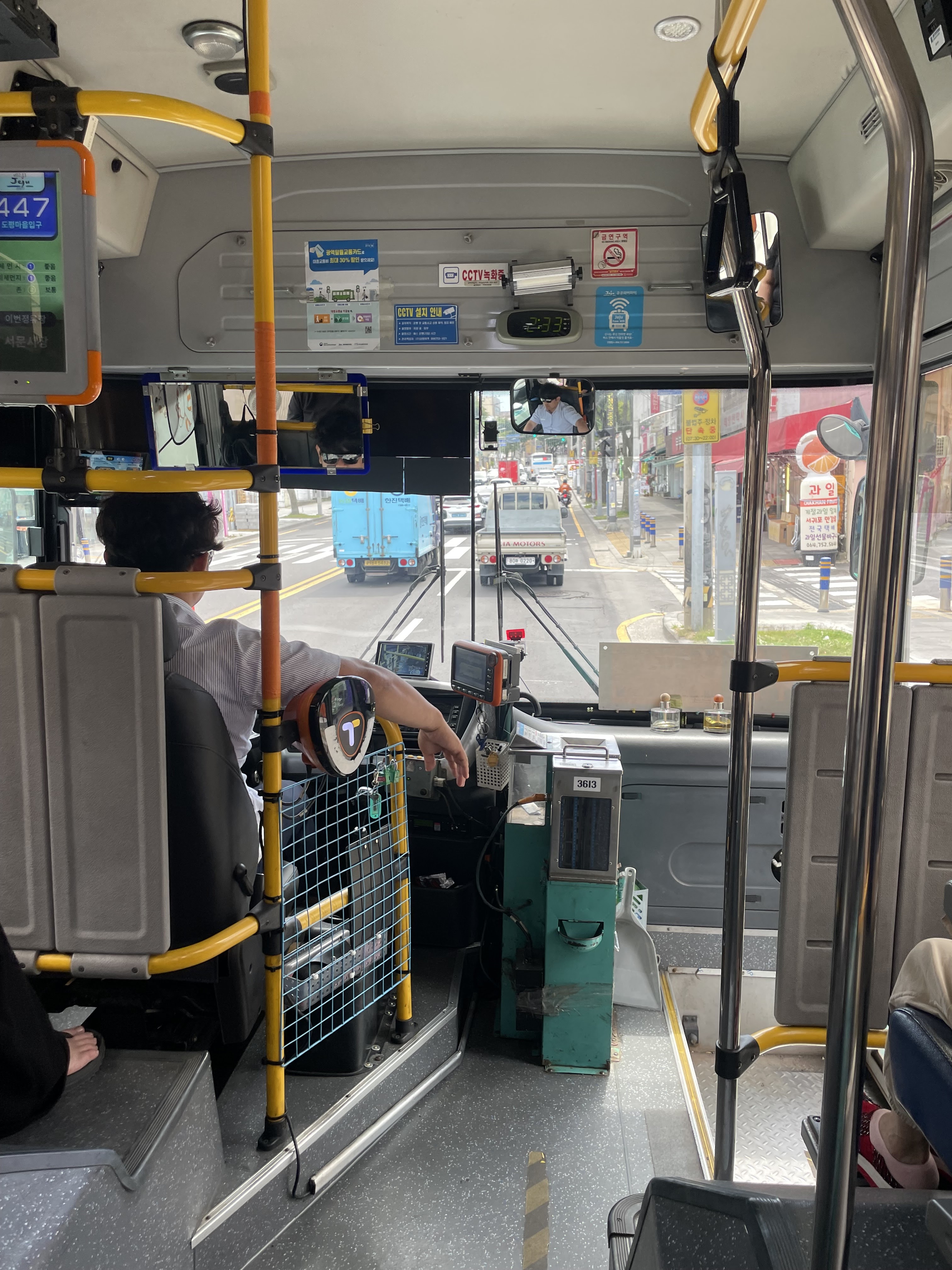
Korea does not have the 49€ Ticket, instead I got a T-card with buying a SIM card. That travel card you can load with cash at machines or in little supermarkets. When you enter a bus or metro area, you put your card on the reader and it will show how much money is deducted from your balance. Also important you also have to validate when you get off which is confirmed with a message “You are getting off” in Korean. If you have connecting buses or metro, the system will recognise and not charge you again or only the mark up for a higher fare.
 

T-Card


Metro in Busan


Compared to Europe most buses in the cities were still high-floor and you had to climb up several steps to get in. Also the second door was not a foldable one or two wing one, instead it was massive metal sliding door like on a van.


Watching from behind the driver


massive second door


One of the few low-floor buses


How to navigate

Google Maps unfortunately is pretty useless in Korea as it has only very limited service. If you speak Korean, Kakao Map is helpful. But even if you enter places in English and it finds them, it then displays everything in Korean alphabet. The best I found for navigation on foot and with bus and metro is Naver Map.


Some curiosities:


 Diagonal pedestrian crossing

Big umbrellas sheltering from rain and sun while you wait for the green light.


Korail

It was a pleasure to travel by train in Korea- Korean rail or Korail offers high-speed trains (KTX, …) that can bring you from Seoul to Busan in less than 3 hours. I travelled by train from Seoul to Jeonju 2nd class and from Busan to Gyeongju 1st class. One ticket I booked via the app, the other at the counter in the train station. The trains arrived at the platform way ahead departure time and a screen per wagon on platform told me where to wait for my coach car. Difference between 2nd and 1st class are the number of seats per row (4 vs 3), legroom and a little snack. A train attendant distributes free water and there are vending machines that offer sodas and other drinks. The train departed and arrived on time.


KTX from Busan


Be sure to board 5 min before departure


my first class seat


Bus

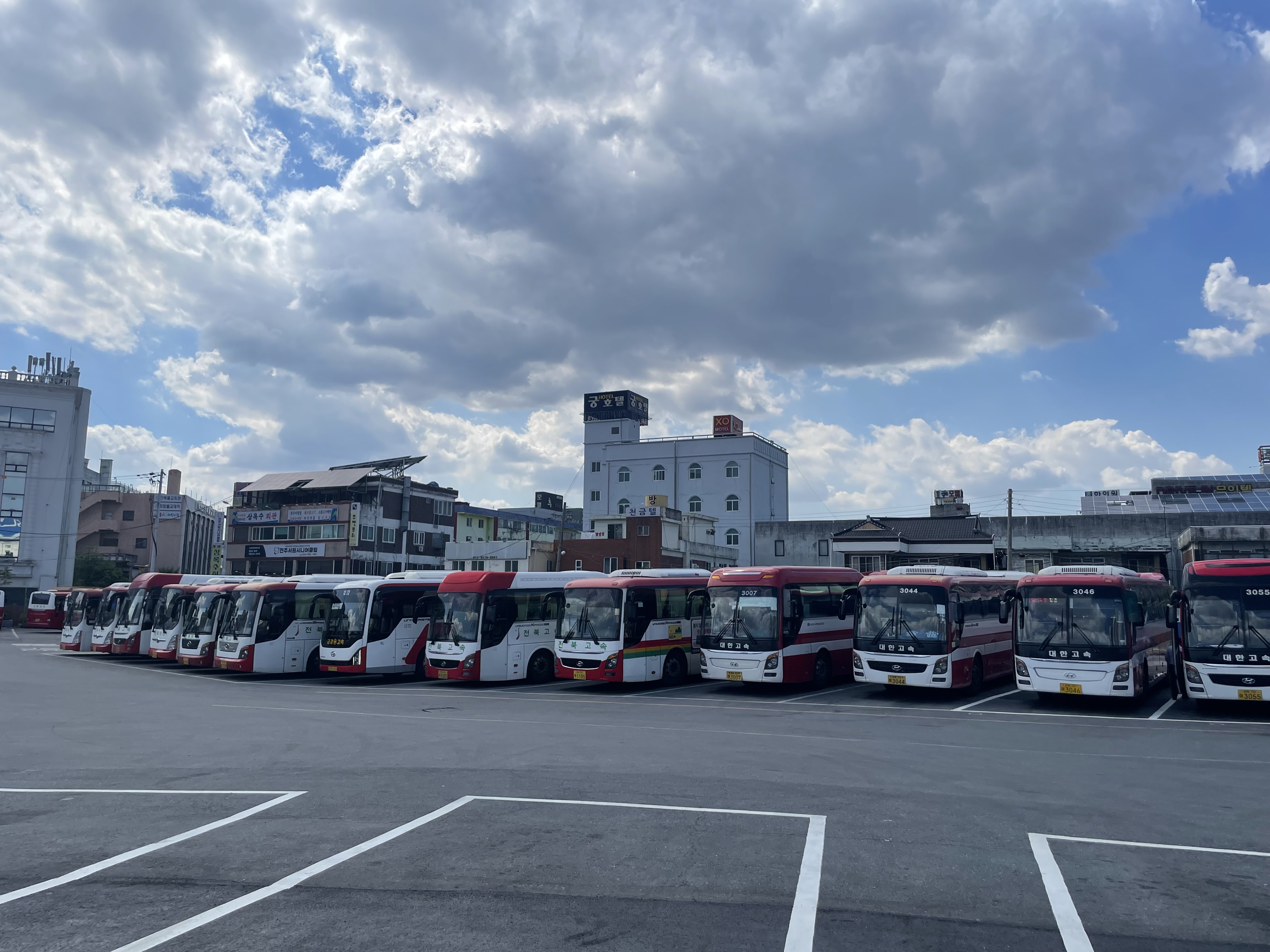
Long-distance buses are an alternative to the rail service and also go places where there are no tracks. There are three bus OEMs in Korea: Daewoo, Hyundai and Kia. I took a bus from Jeonju to Mokpo and fron Gyeongju to Andong. Both buses were rather empty and I had a seat for myself. I bought the tickets at the counter of the bus terminal, there were also machines. I did not have much luck on the internet either websites were in Korean or payment did not work with a foreign card. Buses like trains left on time. Basically, 5 min before departure all passengers were seated, luggage stored, tickets checked and the driver ready and waiting only for the countdown to departure time. Compared to long distance buses in Europe, Korean buses only had one door and were missing USB ports and Wifi.


 Bus Ticket Machines


 Bus line up at the Central Bus Terminal


Kia Coach - one of the three brands in Korea (the others are Daewoo & Hyundai)


Ferry

There are ferry connections between Mokpo/ Busan and Jeju and other places on the Korean coast. Booking the ticket for the trip from Mokpo to Jeju, I countered the toughest website in my preparation for the trip.The website was only in Korean and even with automatic translation on, the booking process at one point did not advance. In the end, I asked EJ to book for me. In Mokpo, I had chosen accommodation close to the Ferry terminal, so I just had to walk down the street to get to there. Unfortunately, once there I realised that it was under construction. Luckily, my host knew about it and offered to drive me to the interim pier about 2 km away. 


Ferry Mokpo-Jeju Island


Welcome abord


As a foreigner, I could not get an e-ticket. Instead I had to show my passport at the pier and got issued a paper ticket. An attendant took care of my suitcase and carried it on board. Even though, the crossing only took 4.5h during the day, with your ticket you booked a room/ bunk. The offer ranged from big naked rooms for 40 people to luxury suites. I had chosen the cheapest option that was available when I booked: a room with 8 bunk beds. I took a quick look and then found an empty armchair in the panorama lounge that was way more comfortable to read, write and work on my laptop. The ferry also had a grocery store, a bakery, a restaurant, pet rooms and an observation deck with a little fake fenced meadow for your dog. We arrived with 15 min delay as the currents were very heavy that day. The number of foreigners was very limited.


My bunk


40 people room


Another shorter ferry experience was the trip from Jeju to Udo island. We arrived at the terminal and had two fill out a paper slip with the names of our group and then a second one for the return trip. The ride to Udo only took 15-20 min and had an indoor floor seating and an open-air seating.


Ferry Udo - Jeju


Car

On Jeju island, I rented a car that I had booked before. 200€ for 5 days - an okay deal. I got a Hyundai Casper with navigation system that was necessary, although it took some time to figure out how to insert the addresses. The system also announced every single speed breaker on the island - and there were nearly as many as people living on the island. It also warned of speed checking cameras, school zones (30 km/h) and other dangers. A good feature were green/ pink guiding lines on the road and in the navigation at confusing crossings. Parking was nearly everywhere for free except at the airport and at the parking garage  near the Olle Market. The Lotte Car Rental shop was close by the airport and ran shuttles every 10-20 min.


Our Hyundai Casper


Follow the pink lines


Lotte Airport Shuttle 


Electric mini car

On Udo island, you have different options to get around: walking, bicycle, e-bike, electric mini car and car. We opted to rent an electric mini car. The two seats were not next to each other but one behind the other. From the system it was more like a motorbike or scooter than a car. And I had no experience with motorised two wheelers. We survived nonetheless.


Mini car survivors


Plane

As the ferry to Busan would have taken about 12 hours, I decided to take the plane. After I figured out that all Sunday afternoon/ evening flights were sold out, it was easy to book a Monday morning flight with Korean Air. At Jeju Airport, there was a big duty free shopping area - but I did not find much to my liking and only looked for breakfast. The flight was short and uneventful.


Nearly ready for take off