Sunday, December 8, 2024

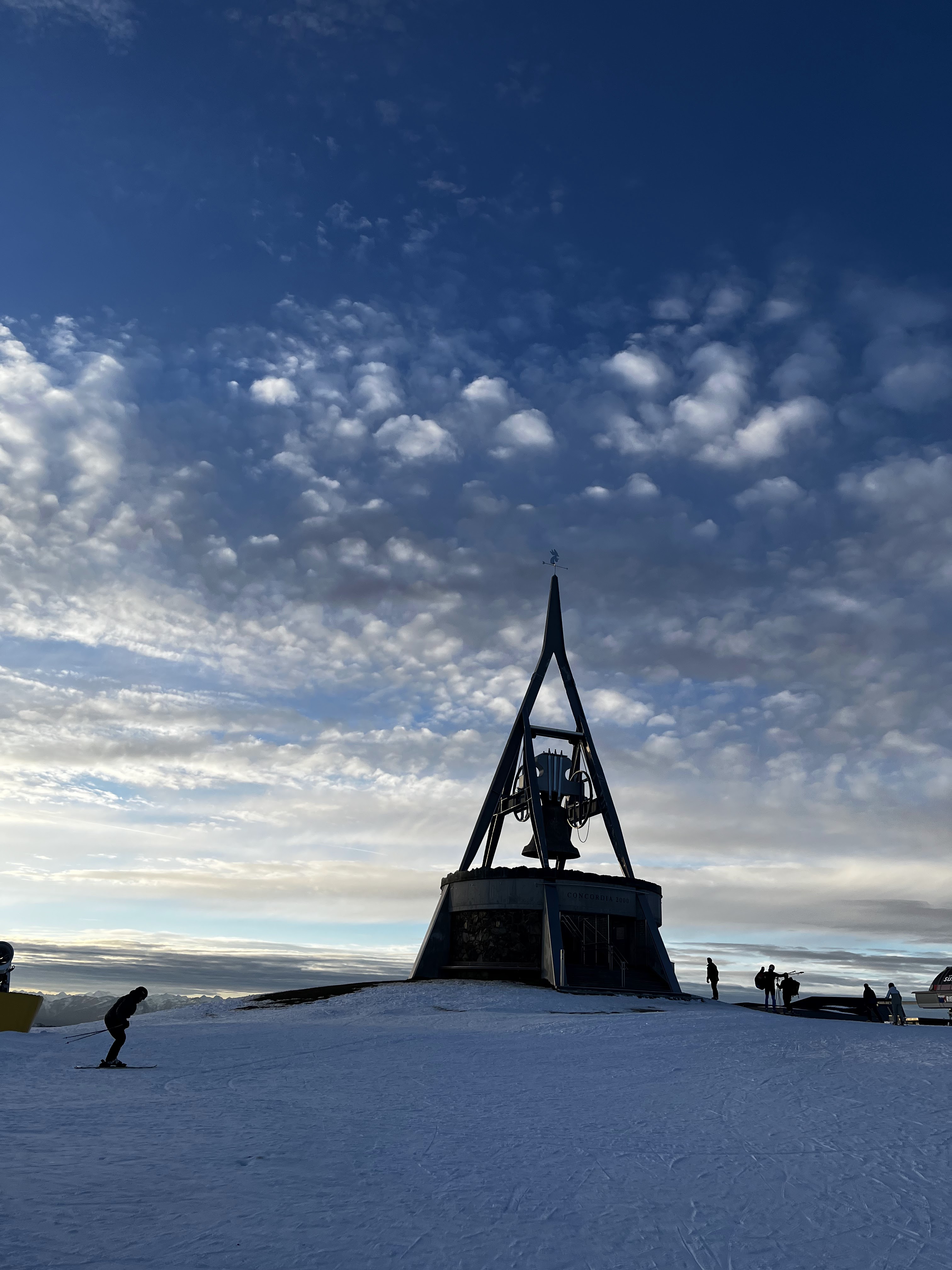
Opening the ski season at Kronplatz

I had the plan to spend the first week of December skiing. Unfortunately, I realized about a month ago that the place I wanted to go to only opened a couple of days before Christmas. 


Kronplatz

So I postponed the decision where to go to the last minute. Making it dependent on snow, train access and qavailable accommodation in the vicinity. I decided for Kronplatz in Italy - 4h away from Munich by train with a transfer in Fortezza. 


When I arrived, I was positively surprised that the gondola started right at the train station. I got myself a locker and a ski pass and headed up the mountain. 


Over the next days I explored the Kronplatz ski area incl. St Virgil, Olang, Ried and Marchner. Some days the sun was shining, other it was snowing. So I was very happy to come back to a cosy and warm apartment in Perca. 

My favorite run was the black Sylvester going down to Kronplatz 1+2: long race tracks and steep slopes framed by snow covered trees.  


Sylvester


Friday and Saturday, I took the train to 3 Zinnen and enjoyed some different slopes there. Ski runs were snow covered back down to the valley and more and more runs were opened during the week. 


Winter Wonderland

3 Zinnen

Saturday afternoon I took the bus (that was free like the train with the guest cars I received) to Bruneck to visit the Christmas Market. As usual there was a good focus on food (e.g. sweets, Raclette and other things) but also handicrafts had their areas. Carol singers strolled around the different areas and sang Christmas songs. 

Bruneck


Christmas Market


All in all, it was a great experience and good accessible by train. 


Church of Perca


Friday, June 7, 2024

Simple history of Korea & a visit to the DMZ

In 1392, King Taejo founded the Joseon dynasty that ruled Korea for more than 500 years. During most of this time, the country remained isolated. King Taejo also invented the Korean alphabet. Before the Korean alphabet, Chinese was used. Interestingly, North Korea was using it since the 1950s while South Korea only adopted it in the 1990s.


Portrait of King Taejo in the Shrine of Felicitous Foundation in Jeonju


In the second half of the 19th centuries, Korea opened up to the outside world and particularly to the west. In 1910, the Japanese empire invaded Korea, demolished lots of old structures (buildings, palaces, etc). As Japan lost in World War II, Korea was divided in 1945 between US/ UN in the South and China and Russia in the North as the agricultural population was not seen as mature enough to rule themselves. 


By 1950, north and south had established own governments and the leader of North Korea decided to invade the south. A three year war period followed that led to an armistice. Both countries remained close in their development for several years, the North showing even better growth for some time. From the 19x0s, they went on a different trajectory.


Fence at the DMZ


Checkpoint to enter the DMZ 


In South Korea, several tour operators offer visits to the DMZ (Demilitarised Zone) which is two kilometres north and south of the boarder. At the time of my travel, visits to the Joint Security Area (JSA)at Panmunjom were suspended as in July 2023 an American soldier had crossed into North Korea during a tour. My tour started very early in Seoul (I was picked up at 6:30 in Itaewon). 

By 7:30, we had reached Imjingak Park where a visitor centre informs about the Korean war times. Our guide took our passports and application list to get tickets from the government office - there was a run on the tickets as there seemed to be more demand than tickets. At 9, he got the tickets and the assigned time for the government bus. 

I had booked a small tor with a visit to a suspension bridge as I thought it belonged to the DMZ. Instead the suspension bridge was only a tribute to South Koreans’ favourite pastime of hiking and has no historic connection. So feel free to skip it.


Suspension bridge


Tour highlights:


Imjingak Park

The visitor centre features several memorials to the Korean war, to reuniting families, to the girls that were enslaved by the Japanese as sex workers for the army. There is showcased a locomotive that has many bullet holes tand which was derailed in the Korean war, the freedom bridge over which prisoners of war were exchanged after the armistice. The park was built for South Koreans to commemorate their North Korean family members before the DMZ was opened.


More and more buses arrive


1950 locomtive with bullet holes


Freedom bridge


 Peace Momunment for "Comfort Women"


3rd infiltration tunnel

So far, South Korea has discovered four tunnels that the North has built to infiltrate the South - they were discovered between 1975 and 1990. More are expected to have been drilled. Some of the four tunnels are open to the public on a DMZ Tour. I visited the third tunnel. Before you go down, you watch a video with a strong American voice talking about the history of the DMZ, the tunnels and the wildlife - it feels strongly like propaganda.


To go down, you have to store your bags and phone in a locker, walk through a security check and take a helmet. Then you walk down a steep ramp for 375 m (down the interception tunnel). At the bottom I saw a wall that was prepped for the dynamite to clear the next couple of meters. I then walked 265 m in direction to North Korea, where the third concrete blockade with a window to see the second blockade marks the closest point you can get to North Korea (170 m). For this tunnel, it’s really good to be small as the tall ones dinged quite a lot to the ceiling of the tunnel.


Ready to enter the tunnel


Dora Observatory 

On the Dora mountain, is the observatory with binoculars directed at North Korea - I could see Chaeson Industrial Complex, Chaeson (city), propaganda village, fields, North Korean military post and radio towers from both side that should block signals from the opposing side. While I looked through the magnifying glass, I did not see any North Korean.


We are watching you!


View of North Korea


Unification Village

The bus stopped there for a 15 min shopping break at a DMZ grocery store that offered products from the zone: rice, alcohol, other food items. That felt a bit like a Kaffeefahrt (cheap coach trip with a sales show).


Unification Village


DMZ Supermarket


Thursday, June 6, 2024

Gyeongju & Andong: Pagodas, Pavilions, and the Shape of History

Gyeongju and Andong came next, and together they formed one of the most culturally dense stretches of the trip. Gyeongju, often called the museum without walls, was once the capital of the Silla Kingdom (57 BCE–935 CE), which ruled much of the Korean Peninsula for nearly a thousand years. That weight of history is felt everywhere.


Combining new and old designs

From the train station, it took about 90 minutes, involving two buses and a short taxi ride, to reach my hotel. By the time I walked in, slightly travel-worn, it became clear just how few foreigners pass through this particular setup. I must have been the only one that day. The receptionist greeted me by name, handed me the key without further ceremony, and pointed out the breakfast time. No small talk, no explanations—just quiet efficiency.

The room was spacious, the breakfast very basic, but the location was excellent, which mattered far more. Everything I wanted to see the next day was close, and in Gyeongju, proximity to history is everything.


Overview Bulguk-sa

Former entry to Bulguk-sa

The following day, I visited Bulguk-sa, one of Korea’s most important Buddhist temples and a UNESCO World Heritage Site. Originally constructed in the 8th century during the height of Silla power, it represents the kingdom’s spiritual and artistic peak. Within the temple complex stand Dabotap and Seokgatap, two stone pagodas that perfectly illustrate the balance and restraint of Silla craftsmanship—one ornate, the other austere, both intentional.


Dabotap                          Seokgatap


From there I continued to Seokguram Grotto, completed in the mid-8th century and now also a UNESCO site. The stone Buddha, seated calmly inside the granite grotto and facing the East Sea, is considered a masterpiece of Buddhist sculpture in East Asia. Even with modern visitor management, the space retains a quiet intensity. It feels less like a monument and more like a presence.


Bus to Seokguram

Little fresh snack from the bus stop


Seokguram


In the afternoon, I returned to the hotel, picked up my luggage, and made my way to the intercity bus terminal, heading north to Andong.


Checking the app again and again until the local bus finally shows up


By late afternoon, I arrived in Andong, where EJ and Miyoung were waiting for me—an immediate shift from solo travel to shared experience. After Korean BBQ dinner, we went to Wolyeonggyo Bridge, beautifully lit at night. We took a moon boat ride, drifting slowly beneath the illuminated structure, the reflections moving quietly across the water. 


Wolyeonggyo Bridge


That night we stayed in a more luxurious hanok, a clear contrast to my functional hotel in Gyeongju. The craftsmanship, space, and silence made the stay feel intentional rather than merely practical.


Our luxurious hanok by night and day


The next morning we visited Manhyujeong Pavilion, a site with real historical weight beyond its more recent fame as a K-drama filming location. Built during the Joseon Dynasty (1392–1897), the pavilion is associated with Confucian scholars and literati, serving as a place for study, reflection, and poetry. Pavilions like this were central to Joseon intellectual life, designed to frame nature rather than dominate it. Standing there, it was easy to see why the location still resonates on screen centuries later.


Manhyujeong Pavilion

the modern scholar looking for wifi or the best photo

We then headed into Andong city for lunch. The pedestrian zone offered a brief tonal shift: alongside traditional references were comic-style figures, playful and slightly unexpected, adding a light, almost whimsical layer to a city otherwise known for seriousness and tradition. After lunch, we stopped for pastries at Mammoth, a welcome modern pause.


Andong mascots


In the afternoon, we visited Hahoe Folk Village, another UNESCO World Heritage Site and one of the best-preserved examples of a Joseon-era clan village. Dating back to the Joseon period, the village still reflects Confucian social order in its layout and architecture. Unlike open-air museums, Hahoe is still inhabited, which gives it a quiet continuity rather than a staged feel. But you also have to pay attention not to end up in someone's backyard.


Hahoe Folk Village


From Andong, we drove back to Seoul by car, the scenery slowly flattening and modernising as we returned to the capital.